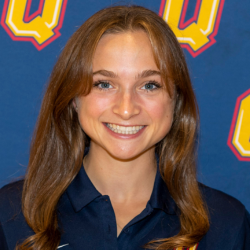
Since graduating from Queen’s University in 2023, Danica has been a Strength & Conditioning Coach with the Canadian Sport Institute Alberta where she works with long track speed skating and ringette athletes. She is also a graduate student at the University of Calgary where her research focuses on exercise physiology and women’s health. Danica also did a 10-month Strength & Conditioning internship with the Calgary Flames after moving to Calgary to June 2023
While at Queen’s, Danica was the lead intern for Queen's Women’s Basketball as well as for the return-to-sport program. She was on the varsity rowing team from 2019 to 2022 before getting more involved with the Athletics & Recreation Department as a group fitness instructor and supervisor for the Prescription Exercise at Queen’s program.
Danica will be attending medical school at University of Alberta Faculty of Medicine and Dentistry starting this fall.
Can you share your journey into strength & conditioning and what drew you to this field?
My answer to this question is not glamorous: I wanted to add a hands-on component to my degree. Being in kinesiology, I had the option to apply for athletic therapy or to strength & conditioning but, because I was on the rowing team, I was ineligible for athletic therapy. Knowing that I had been enjoying my S&C experience training with the rowing team and looking to dive deeper into the methodology behind our training, I threw my name in the hat for S&C. From the start, I’d consistently said that I didn’t plan on working in a gym after graduating… and here I am.
For me, the more interesting question is what kept me in this field. Going into the ministream, I expected to learn about sets and reps, programming for sport-specific demands, etc. etc., but I was caught off guard by the connections I was making and the passion of the people around me. I love this field because it creates genuine connections, and I love how much people in the sporting world care about their jobs and the people they work with. I also love the leadership element of coaching as well as the potential to help athletes optimize their development.
How did your experience with the Queen’s ministream help prepare you for your current role?
The Queen’s ministream gave me my foundation: through the ministream, I gained a fundamental understanding of training science while learning the hands-on skills to lead groups, to think critically in real-time and in athlete-facing positions, and to provide clear and relevant feedback.
More importantly, the Queen’s S&C ministream showed me the strength of the S&C community and the value of coach-athlete relationships, both of which got me hooked.
What did your role with Queen’s Athletics & Recreation entail, and what did a typical day look like for you?
As a level three intern (i.e., in my fourth year), I was the lead intern for the women’s basketball team as well as for athletes returning from injury.
With women’s basketball, I ran weight room sessions and helped with pre-practice warm-ups. The core of this role—as with most positions in the ministream—involved facilitating and coaching weight room sessions. In a nutshell, you’d arrive at the varsity gym about 15 minutes before the session to set up, triple-check the program, and coordinate with the other interns. In that time, you’d decide who would be running the warm-up, who would be explaining and demonstrating exercises, and who would be running testing (e.g., vertical jump, timing gates).
From there, athletes would show up, you’d go through warm-up then move straight into the lift. During the lift, you’d circulate and correct form if needed, but a good chunk of session facilitation involved reminding athletes of their sets and reps, helping to set up squat racks and other equipment, and keeping time for planks and whatnot. You’d also be checking in with athletes, chatting about their days, and asking how their seasons were going. A lot of the role was establishing connections and making sure athletes had what they needed to succeed.
Once the session was over, you and the other interns would debrief and tidy up the gym. Then, you’d go off to your next lift or to class.
In my return-to-play role, I was a student liaison of sorts—I communicated with our injured athletes, asking them how they were progressing and what they needed from the S&C practitioners. I also helped adapt return-to-play protocols from other facilities to our Queen’s resources, focusing primarily on knee return-to-play protocols.
Like with a regular weight room session, connection was a key aspect of this role. Athletes returning from injury often need a bit more support—emotionally and programming-wise—and this role was designed to ensure athletes felt comfortable as they returned to sport.
Lastly, I was an undergraduate TA for KNPE345 which was The Science and Methodology of Sport Training Conditioning Programs course that our level one interns took in the first year of their internship. In this role, I assisted with one lab per week, helping Evan with demos, set-up, running the lesson plan, and answering questions.
I was also involved with a few other positions within the Athletics & Recreation Department. I was a spin instructor, Learn to Weightlift instructor, and the supervisor for the Prescription Exercise at Queen’s (PE-Q) program. As such, most of my time in my fourth year was spent at the ARC – either down in the varsity gym or up in one of the fitness studios… plus squeaking in a class or two, of course.
The ministream programs emphasize mentorship and applied learning, how have those elements influenced your development?
I find that working in a coaching profession, all of your colleagues—rightfully so—love to coach. As such, colleagues will almost always be happy to provide feedback or to teach you about a new concept, but it’s easy to shy away from asking for help or admitting you don’t know something.
The ministream really set the tone for not only embracing feedback, but also for seeking it out and chasing new opportunities to learn. In a role where your personal coaching style is so heavily involved, it can be scary to ask for feedback, but the ministream reminded me that it’s okay to not be perfect and it’s okay to ask for help.
I also think the hands-on, applied aspect was crucial. Early on, Dani encouraged us to find our “coaching voice” and to learn to establish our presence in the weight room. This was such an important piece of advice to hear early in our S&C careers because it helped us develop our own coaching styles, but it also took a lot of reps to get comfortable with.
By leading warm-ups and coaching sessions, we got plenty of practice finding our coaching voices, but we also learned to deliver instructions and provide feedback in concise ways. Since being a coach, I’ve learned that it’s easy to learn how to do something or to memorize information, but it’s much harder to convey that information to others in a way that they’ll understand.
The ministream gave me tons of practice in delivering information, reflecting on and refining that delivery, then delivering the improved version. It also helped me learn to say the same thing a dozen different ways so you always have a back-up plan if your athletes don’t understand the first time.
This is a skill that can only be achieved through real-life practice, and I’m so grateful I had the opportunity to build that skill before seeking opportunities outside of Queen’s.
Looking ahead, what goals are you working toward in the field?
My goals in this field are two-fold: to continue growing my skills on the floor as an S&C practitioner, but also to keep developing on the sport science side.
On the S&C side and through my work with long track speed skating at the Canadian Sport Institute Alberta, my first goal is—of course—to help my athletes continue to develop and excel in their sport.
I’m also wrapping up my master’s degree at the moment, and plan on starting my PhD in the fall which should help with expanding my sport science capabilities. In a perfect world, I’ll be able to integrate my doctoral studies into my S&C practice so help me grow on both sides together.
We’re also in an exciting time for women in sport where we’re starting to see more female representation in coaching, management and support team roles. This is partially a personal goal and partially a goal that I have for the industry, but I would love to see this representation continue to expand and to help support this growing community however I can.
What advice would you give to students considering a path in strength & conditioning?
Embrace your authentic coaching style. The old S&C stereotype paints a picture of a burly, male football strength coach with his arms crossed, straight face, and harsh demeanour. There was certainly a time in my S&C career when I would’ve tried to emulate that stereotype, but it took me a little too long to learn that that style did not suit me nor did it make me a better coach. Once I got comfortable with my own coaching style, my job became so much more fulfilling—I developed better relationships with my athletes and fellow coaches, I felt more confident in my programming and delivery, and I just had more fun.
If you’re able to do so, embrace opportunities to work for free, especially early on. If you can support yourself through other means, I would recommend taking advantage of one of the many interesting (and unpaid) internships that expose you to new and interesting populations. It’s not always glamorous work and you probably won’t love every minute of it, but exposure to real-life S&C and real-life sport will pay dividends.
For most people, working in sport is not about making the big bucks, but there’s a trade-off: you work with people who love what they do and who are passionate about what they do. This is by no means a universal rule, but I’ve experienced it myself and seen it among many of my colleagues—we might not have benefits or great job security, but we sure as heck love our jobs. If you want to work in sport, I would say it’s important to be aware of this trade-off and to make sure you can live with it, resentment-free.
